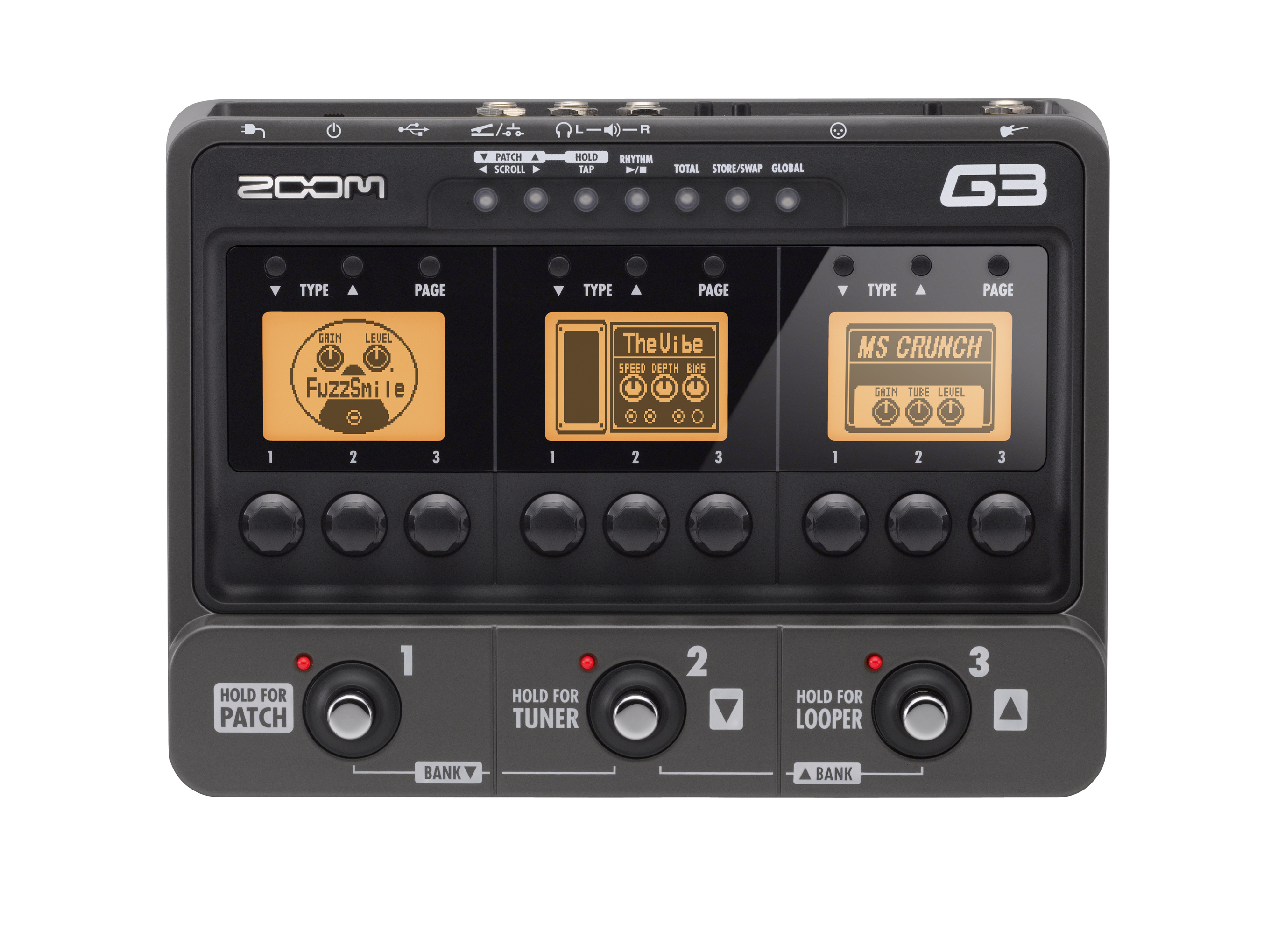
The G3 is Japanese multi-fx manufacturer Zoom's latest product introducing their new proprietary ZFX-IV processor which serves up 13 amp models and 94 effects. The inputs and outputs the G3 offers considering its compact size (roughly 2 1/2 Boss pedals on a board) is impressive: 1/4" input with a switch for active or passive pickups, stereo 1/4" outputs with the left out doubling as a stereo headphone jack, USB, a control input for use with an external expression pedal or foot-switch, and a balanced XLR output with a ground lift and the option to tap your signal pre-processing for dry tracking. In today's multi-fx market, it seems every company attempts to offer an everything and the kitchen sink box. As such, the shear number of effects a unit contains has kinda lost its shock value at this point. That being said, the selection Zoom has chosen to include (13 amps/94 stomps with quite a few avant guarde options) plus the of three effects locations in which any effect can be placed in any order including multiple instances. Sweet! In the Zoom tradition, the G3 can be powered from a standard Boss style DC adapter, run off batteries, or even powered via USB. The back panel also features a 3 way power switch with standard on and off positions plus a middle position which automatically powers the unit down after a period of non-use. Zoom also incorporates a power saving feature which will dim the 3 LCD displays after a user set length of time to conserve energy. Very nice!
Far Beyond Driven
Historically, I've felt Zoom excelled at higher gain tones offering stomp box modeling which often had nearly double the gain of their real world counterparts and the G3 offers the same style of processing. The gain and level the dirtbox models offer generally exceed their real world counterparts, at times by a significant factor. Additionally, Zoom has opted for more generic parameters rather than modelling each dirt boxes actual controls. While those seeking authenticity will be bummed, what matters most to me is sound quality. Zoom has delivered a nice collection of highly coveted pedals such as the Ibanez TS808, Marshall Gov'ner, Pro Co Rat, and Electro Harmonix Big Muff. But they've also included some very unique options such as a hybridized Marshall JCM800/ADA MP-1, Matchless Hotbox, and something named ExtremeDS which the manual describes as having "the highest gain in the world".
To test the units drives, I used it into the front end of a ZT Club and VHT Special 6 Ultra, two radically different amps at opposite ends of the tonal spectrum. In both scenarios, the unit performed well offering believable results from subtle grit to punishing grind and everything inbetween. I found a many of the models got a little too dirty too quickly making them difficult to dial in, and the output of several pedals forced me to run them at minimal settings to achieve unity gain, but of course so many options are on tap that if one model doesn't quite work for the scenario at hand another will. Strangely, I didn't like the dirtbox tones as much when paired with the internal amp modeling. In almost every case, the resulting tone sounded like the front end of an amp being overdriven by a boost even when the modeled dirtboxes were set at fairly minimal levels. Fortunately, there is no shortage of gain on the amp modeling side, but those looking for specific in the box tones from a pedal/amp combo (like say a Tubescreamer into Marshall) may be slightly disappointed.
Cranking up the gain [of the TW Rock model] between 9 and 11 o'clock I found myself desperately channeling Robben Ford and Larry Carlton. Impressive!
The Number 13
The Zoom G3 offers 13 amp models including a handful of the usual suspects such as a Marshall Plexi, Mesa Dual Rectifier, Vox AC30, and a pretty convincing Fender Twin. However, in my opinion the best amps in the box are the TW Rock, a model of the Dumble inspired Two Rock Emerald 50, and FD Vibro, modeled after the Fender Vibroverb. These two models alone cover about 90 percent of the types of tones I typically use. The FD Vibro can nail a cleaner tone with just a touch of hair around the edges moving smoothly into bluesy grit. Cranking the gain to max elicits a pretty sweet moderate drive which for some reason brought to mind Todd Park Mohr (of Big Head Todd and the Monsters) and Ian Moore. The TW Rock picks up right where the FD Vibro leaves off delivering a sweet midrange rich grind that with some tweaking can cover nearly any dirty tones one could want south of the hardest hitting metal. At low gain settings there's excellent note definition and sustain, more or less the textbook definition of clean drive (yes, we guitarists can be an oxymoronic bunch). Cranking up the gain between 9 and 11 o'clock and I found myself desperately channeling Robben Ford and Larry Carlton. Impressive! For those looking to bring the pain, models of the JCM2000 and Diezel Herbert are offered both of which offer a nice tight low end and pick squealing harmonics the likes of which Zakk Wylde might even envy. All of the models share common controls of volume, gain, three bands of eq, presence, cabinet selection, and a curious control named tube which Zoom claims to impart some power amp "sag" onto your tone. In practice, it reacts very similarly to post amp compression (with perhaps another moderate gain stage) and is a really nice touch allow you to dial in more squash and gain even when the amps gain parameter is maxed out. However, that extra squash comes at the price of a higher noise floor which can easily get out of control with noisier single coil pickups. Of course, you can use a noise gate to squelch that extra noise, but then you loose one of the precious few spots for an additional effect.
Effected
Zoom has included a vast array of effects which run the gamut from tape delay and undulating modulation to bit crushers and analog synth emulation. Seriously, there's more than enough stuff on tap to keep even the most frantic tweaker busy for a long time. I've always felt Zoom did a good job in general effects processing and the flexibility of the unit combined with the quality of delay/mod effects is probably worth the unit cost all by itself. You get multiple varieties of everything and the quality across the board is excellent. Seriously. For example, every type of delay I can think of is served up (12 different types with a max repeat time of 5000ms) including some truly unique options such as the pitch delay in which every repeat rises or falls by a user set interval or the triggered hold delay in which you get a infinite repeats which are triggered by picking. The mod side the G3 offers six different flavors of chorusing ranging from subtle detuning to lush ensemble voicings, three phasers (including a very cool dual phaser), three flangers, tremolo, an absolutely sweet rhythmic slicer effect, pitch, and a few other odds and ends. Across the board, any effect with a rate or time parameter offers not only manual control of speed/time, but tempo sync (by manual entry on the global menu or tap tempo using the dedicated button on the control face or an external pedal) with the option of several different subdivisions of the beat.
Overall the Zoom G3 is an extremely impressive unit...In the past I might have looked towards Zoom's more affordable processors as a good option for the money, the G3 seems almost too good a deal.
And in addition to all those other goodies, Zoom has included a 40 second looper (20 seconds if the undo feature is enabled) which can be operated in a manual mode where start and start points are set based solely on when you engage and disengage the looper or quantized to the tap tempo and accompanied by built in drum patterns. The looper isn't an afterthought either featuring foot-switch access to play/stop, overdub and clear functions.
I should note that I was less impressed with many of the G3's pitch and synth effects (specifically the polyphonic pitch shifter and their Z-Organ effect which attempts to emulate the Electro Harmonix MicroPOG) which tend to exhibit a latency significant enough to irk me and some tonal instability. Though I find it hard to criticize the unit too harshly in this area as no other competitively priced unit (including much more expensive flagship processors from competitors) even attempts polyphonic pitch shifting. Even with my lack of enthusiasm for the pitch shifting, the G3 just seems like an almost perfect pedal board replacement option due to its nice compact size, ease of operation, and excellent sound quality.
Impressed...
Overall the Zoom G3 is an extremely impressive unit. Honestly, it feels almost like a turning point for the brand...and awakening if you will. That's not to say they haven't put out some good products in the past, but the G3 is just so incredibly well thought out and flexible in application. For example, if you want 3 different types of delay to kick on individually or all at once, you got it! Zoom even offers some dual combination of effects to expand its flexibility. Add to that the fact an external expression pedal can be assigned to control volume without losing an effects slot, the looper is always available, and in some chains (there are limitations to the unit's power which can be hit such as using the HD Reverb with a dual effect) you can push the units abilities to six effects. And the efficiency in design is apparent throughout such as holding the middle button for a couple seconds to engage the tuner...and then couple more seconds for muted output tuning.
In the past I might have looked towards Zoom's more affordable processors as a good option for the money, the G3 seems almost too good a deal. While it doesn't quite compete head to head feature-wise against some competitor's all-in-one units, those with simpler signal chain needs will find a ton to like here...and the Zoom G3 is an absolute "must audition" for those looking for a multi-fx with a small footprint to replace several dedicated pedals.
Price: $199
Pros: Great selection of good sounding effects and amp modeling with 3 available at once
Cons: Less than stellar polyphonic pitch processing
G3 Demo by FrugalGuitarst
1868 views