If my memory serves me well, Line 6 was the first company to actually advertise the actual name of the amps they modeled. They even took it a step farther claiming to not model based on schematics or theoretical, but discussing and describing specific amps to which they painstakingly compared in order to ensure ultimate authenticity, an absolutely brilliant marketing move painting the illusion of owning a room full of expensive vintage amps at a very affordable price. As such Line 6 has long been a leader in the world of modeling, but to a great degree the tones generated have been a bit polarizing with some championing the accuracy of their modeling while others claiming their digital algorithms can never compete with the real thing. Even among those who embrace digital modeling, there has been a lot of criticism of fizz in the high gain models and an overall lack of feel. Line 6 looked to address these criticisms with the release of their new HD series which feature all new “high definition” modeling algorithms rebuilt from the ground up. The initial hype has a great many toting the Line 6 party line, but are these new floorboards really all that? Let’s dissect their current flag ship model, the POD HD500, and find out...
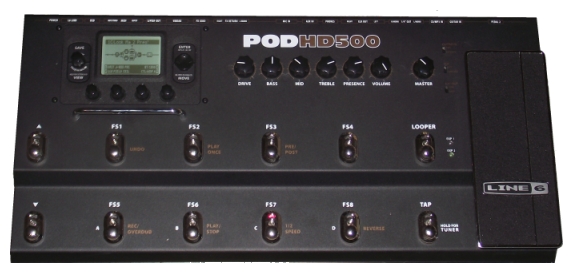
First off, this is an very feature ridden processor rivaled only in complexity, assign-ability, and internal routing by Boss’ GT-10, a unit often criticized for it’s complexity. Line 6 has opted for an architecture based around the unit’s DSP (digital signal processing) limit rather than locking the user into a set order or number of effects. This feature is unique to the 500 in the HD line and offers the user a virtual signal chain which can be split in to dual signal paths and any effect (up to 8) can be placed in any order on the main or within either of the split chains. You want five tubscreamers and three delays? You got it. Want to run dual parallel pitch shifters? You got it! How about dual amps? You got it...almost. This is where you start to run into the DSP limit. The unit can handle any two amps fine but try to add much more than a dirtbox and reverb and you’re out of luck. While the ability to run dual amps in parallel will be a feature I imagine studio cats and home recording enthusiasts will dig, the live usage of this feature is a little limited unless you’re more bread and butter when it comes to effects. Virtually any parameter can be assigned to the on board dual expression pedal (a toe switch toggle between expression one/two), optional external second expression pedal, or toggled on./off by eight of the ten footswitches (looper, tap, bank up/down are reserved). The switches can even be assigned to toggle multiple effects. And patch changing is super fast, fast enough that I you could easily call it instant. Very nice! The POD HD 500 includes numerous ins/outs including dual XLR/1/4” outs, headphone output, a main and aux input, XLR mic input, MIDI, SPDIF, USB, Variax (for use with Line 6 Variax guitars), and Line 6 Link (for coupling to the new DT line of amps).
Programming the unit is actually pretty intuitive. All the amp controls (and the master volume) have dedicated knobs across the face of the unit allowing quick and painless adjustment. Everything else is controlled by a bank of four rotary encoders which offer an intuitive matrix style control. The first dial selects the category of effect, second the specific effect, third the effect parameters, and forth the parameter’s value. A four way button control, four flush mounted buttons and a dual knob/button are provided for some of the deeper functionality and system settings of the unit. But all this talk about features and programming is nonsense if the unit doesn’t sound good, so let’s get to it.
...the Park 75 and Marshall JTM-45 MkII models are perhaps the most authentic...However, my favorite amp model may be the Divided by 13 model whose dual interactive gain controls allow a wide range of gain options covering almost any style...
Line 6 has pared down it’s gargantuan list of amps modeled in its previous generation of products down to 16. That’s right, only 16! While this seems rather slim compared to the competition, they’ve carefully selected a nice collection of timeless classics and modern boutique amps which run the tonal gamut. The list consists of the Bogner Uberschall, Divided by 13 JRT 9/15, Dr. Z Route 66, ENGL Fireball 100, Fender Bassman, Fender Blackface Deluxe Reverb, Fender Twin Reverb, Gibson EH-185, Hiwatt Custom 100 (DR103), Marshall JCM-800 (2204), Marshall JTM-45 MkII, Mesa/Boogie Dual Rectifier, Park 75, Supro S6616, Vox AC-15, and Vox AC-30 (Top Boost). Before speaking on how things sound, a brief note on Line 6’s modeling approach. Line 6 doesn’t take the approach of trying to model an idealized version of an amp, but strive for ultimate realism including the warts and all. If the modeled amp exhibits ghost notes when playing in certain registers, so does the model. Even the AC hum is modeled. One the one hand, I must applaud their dedication and they get an A for effort. But all the same, I wish Line 6 had allowed more control over these tonal idiosyncrasies allowing them to be dialed down or turned completely off.
Now to the tones. In this reviewer’s opinion, the Park 75 and Marshall JTM-45 MkII models are perhaps the most authentic. Vintage Marshall tones have been a strength of Line 6 products since I can remember. The low end delicately teetering between big/warm and tight, the complex mid-range, the krang, it’s all there and it sounds damn good. If your tonal Nirvana lies between Angus and Eddie, I think you’ll be more than satisfied here. A big surprise was the Gibson EH-185 which I keep finding myself coming back to. I’d never even heard of this amp prior to giving the HD500 a spin, but its certainly an amp I’d love to check out in person. The AC-30 is among the better I’ve heard nailing the Vox chime and shimmer and though I’ve never played a Dr Z, I’m certainly digging Line 6’s interpretation of it balancing bite with a nice slightly saggy attack. However, my favorite amp model may be the Divided by 13 model whose dual interactive gain controls allow a wide range of gain options covering almost any style, at lower gain settings it has a sweet high end clarity and rich mid range crunch which blues and country players are really going to dig but upping the gain gets you firmly into roots rock and even 70’s era hard rock. I could easily do a whole gig with just some minor variations on this model. Very nice!
I didn’t have quite the same enthusiasm for the completely pristine side of things. Now I’m being a bit picky and holding Line 6 to a high standard based on the marketing of this new line, but the response when trying to dial things in absolutely clean without a hint of breakup isn’t quite there. Things just feels a bit stiff for lack of a better word, particularly with the Fender models. In fact, I did not find the overall dynamic response/feel to be significantly better than the competition nor close to dynamic as several analog dirt boxes I have, and I’m talking affordable options not high dollar boutique stuff. I should add that this appears to be a minority opinion based on the general consensus on several forums, as such your mileage may vary. Even with that criticism, I must state that every model is more than usable...a situation which is rather uncommon with modeling devices which typically include a plethora of choice with only a few models which are actually usable. I’ve run the unit in every possible scenario I could, into a pair of M-Audio monitors, using a few different types of headphones, into the front of a VHT Special 6, and into the returns as well as using the 4 cable method with both a Tech 21 Trademark 60 and ZT Club. While the unit performed admirably in all the scenario’s, things sounded most convincing using the return of the Tech 21 TM60 with the POD’s cabinet emulation disengaged. I should note that the response of the return of the TM60 is far from flat and full range, so take that for what its worth.
Line 6 has included a bunch of extremely inspiring synth-like filter and ambient pad styled effects...Fans of artists like Radiohead, Muse, and the Edge will have a blast dialing in everything from resonating howls to cosmic chirps.
Another big selling point of the HD line is the incorporation of Line 6’s hugely popular ‘M’ series of effects. First off, the looping on the HD 500 is implemented better than any of the competition by a long shot. It is always available by clicking the dedicated looper footswitch and once engaged, seven of the eight middle footswitches are dedicated to triggering looping and playback (including ½ speed and reverse). You can even toggle into and out of looping mode with the loop still playing and switch patches. Unlike some of the competition which treats looping as sort of an after thought, Line 6 has really given looping its due respect. Kudos! Also very well implemented is delay of which multiple flavors are included to meet the appetite of almost anyone from dirty and dingy to pristine and everything inbetween. I wasn’t as inspired by the dirt boxes, of which the selection are overly focused on fuzz pedals. While Line 6 did a very good job with the Tubedrive and Screamer models (the Chandler Tube Driver and Ibanez Tube screamer, respectively), a couple others come off a touch brash. Even more discouraging were the Univibe and Rotary effects which sound like some kind of modulated tremolo instead of the swirling ramp of the real deal. Another slight disappointment was the lack of control provided in the compressors. Granted, they’ve included controls of the modeled originals but the majority offer only two parameters; a real handicap for those who like precise control over their compression ratio, attack, and sustain. One more little bother is that modulation effect speeds are denoted in hertz. While this is technically accurate, I’m a musician and think in beats per minute (BPM) not cycles per second. Thankfully, Line 6 also included the option of musical division of beats easily synced to the tap tempo switch.
Back on the plus side of things, Line 6 has included a bunch of extremely inspiring synth-like filter and ambient pad styled effects for the more experimental player. In fact, the analog sounding girth and growl on tap are among the best I’ve experienced without requiring dedicated hardware and/or a hexaphonic pickup. Fans of artists like Radiohead, Muse, and the Edge will have a blast dialing in everything from resonating howls to cosmic chirps. You can even get pretty close to the synth lead tones of Metheny and Holdsworth. Honestly, I’ve not played another modeling device with the breadth and quality of avant garde effects allowing the transformation of your guitar into more or less a synthesizer. The vast majority of these effects are intended for monophonic usage, which feels a touch limiting at first. However, the unexpected glitchy-in-a-cool-way results of playing two or more notes on a couple settings was simply mind blowing. I realize these effects won’t be appreciated by many, but the fact that Line 6 choose to include them anyway is a huge plus in my book. Two thumbs way up!
Finally, the pitch effects are well delivered. Tracking was spot on even during fast runs and the tone of the synthetic harmonized notes is very organic and glitch free. I didn’t particularly care for how the smart harmony effect was programmed using a relative key identifier for mode. Being a player who thinks in chord/mode combinations rather than relative major key, it would be far more intuitive to select “A Dorian” rather than “G Major” when choosing a preferred harmonization for a Amin7 chord.
The POD HD 500 certainly offers a lot to love. The $499 price tag is quite a bargain considering the flexibility of programming/virtual routing and the quantity/quality of effects. While the modeling is generally good to great, things still have a touch of Line 6’s sonic fingerprint. And in my opinion, the claims of a vastly improved feel are just a touch oversold. If you’ve never been a fan of the sound of Line 6 gear, amp model-wise this unit might be a bit of a hard sell. But the POD has oh so much more to offer than just amp modeling. Anyone considering an all in one floor processor would be doing themselves a disservice by not checking out the POD HD 500.
Price: $499
Pros: Good to great amp modeling/effects, flexible routing/programming architecture
Cons: Poor rotary/univibe emulation, difficult to dial in pristine clean tones which retain an organic feel.
2773 views