Through my years of playing, I often feel like I’m on a gear merry-go-round spinning between traditional amp and pedal board rigs and multi-fx/modeling units. Both have their strengths and weaknesses but with the recent advances of the Digitech RP and Line 6 POD HD line I may be coming closer to moving to a modeling based rig for good. That’s not to say I won’t still enjoy plugging into an amp and cranking it to 10, but current modeling units just present a very compelling argument consolidating nearly everything one could want into an economical and practical unit. Then there’s the flip side of the equation. Sometimes, I like to experiment looking to find ways to make my guitar sound closer to a synth and in these cases a traditional rig requires so much outboard gear that it becomes nearly unmanageable. As such, I thought I’d venture to the dark side of guitar rigs...the full range/flat response monitor.
First, a 10,000 foot primer. A full range/flat response (FRFR) monitor is essentially the type of thing you’d see in a club/auditorium FOH(front of house) system typically consisting of a larger diameter woofer to handle the mids and lows paired with a high frequency “horn” (commonly a piezo, or in more expensive systems ribbon, tweeter to handle the highs). In order to divide the signal into the lower and higher frequencies, these systems employ something called a crossover which can be as simple as a passive system consisting of a single capacitor to much more advanced active analog and/or digital circuits including complete biamping of the single (ex a 300 watt system with 250 dedicated to the woofer and the rest for highs). A common issue with such systems , especially in more affordable units, is they tend to place the crossover frequency in the midrange right where the guitar lives.
In typical Frugal Guitarist fashion, my goal was to find a unit under $300 which would not only sonically pair with the Line 6 POD HD500 but also work for vocals. A modular style unit was also a concern in able to scale it bigger (and louder) in the future if needed. A 12” speaker was also on my list as utilization of a 15” for guitars just seemed completely alien to me (I can justify digital modeling and a PA cab for an amp, but can’t justify using a 15” speaker...sheesh). The unit needed to be loud enough for rehearsal with a band as well as fill in as a makeshift PA for smaller gigs in which there wasn’t one provided. Also, I wanted to limit my selection to what was easily available to audition and return if it didn’t cut the mustard. While there may be better and/or cheaper solutions, I didn’t want to mess with return shipping cost and delayed refunds. As such, I headed out to my local GC. Unless otherwise noted, the following conclusions were made auditioning the systems over the course of a few days a piece becoming as familiar with each piece as I could.
Harbinger APS12 ~$200 - Harbinger was once a big name in live sound. This is not that company. Apparently, Bain Capital has bought the name and it is the house brand for their retailers (Guitar Center, Musician’s Friend, Music 123, et al). This is a very feature rich unit especially considering its rock bottom price...which is often a red flag for me. I’m all about a bargain, but when things seem too good to be true...well lets just say the the APS12 may be 150 watts, but they're some of the dirtiest watts I've heard. As such, I didn't spend much time on this one just briefly auditioning in the store.
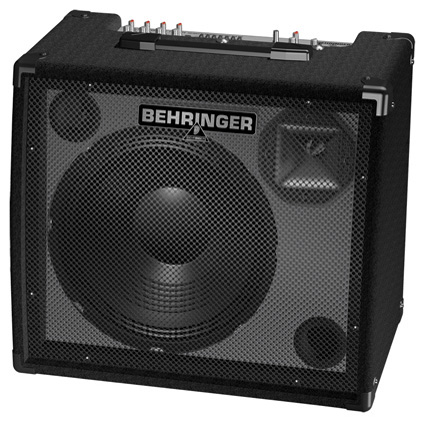
Behringer K1800FX ~$270 - I previously owned one of these and used it with a Digitech GNX3000 and I recall there being a lot to like, so I’d figure I’d give it another go with the POD HD500. Response is tilted more towards the mids and highs, but a built in graphic EQ allows tailoring the tone to even out the response. Its really a mini-PA as it has a built in 3 channel mixer, actually a better option than any PA system I've seen in this price range especially considering the built in effects (with individual effects level control per channel) and multiple I/O options. The unit even has the ability to run stereo using a second unit as a slave and a subwolfer output for transforming it into a full blown PA system. I found it much easier than I like to overdrive the tweeter with the HD500 (though never had the issue with the GNX3000), which if you've never heard before sounds essentially like turning off cabinet modeling. Of the auditioned units, its the closest to a traditional guitar amp featuring wood (likely MDF) construction in a cube design (the rest were plastic shelled wedges). A very loud 180 watts, but heavy (40+ pounds) and somewhat bulky compared to the other options. You can read my full review of the Behringer K1800FX here.
Behringer B212D ~$270 - A few years ago, I had auditioned the Behringer B212A (full review of the B212A can be found here) and found them too boomy tuned more for the DJ market than for traditional live sound reinforcement. Behringer refined that design with a class D power amp in the new B212D reducing the weight and upping the wattage to 550 (450 watts peak to the woofer and 100 watts peak to the tweeter, RMS was specs at 345 watts total), so I thought I’d give them a shot. For the tones I dig, the bass and lower midrange was still pretty heavily over emphasized. Even turning down the built in dual band EQ’s low control (centered at 80hz, a high end control is also included centered at 12khz) all the way down, every amp model on the HD500 sounded like a cranked up 4X12 cabinet with a deep low end thump. Though perhaps with an an external mixer with a more versatile EQ (or even a dedicated EQ unit) the low end could be tamed for more traditional tones. That being said these are extremely loud, likely louder than you’ll ever need. And if you're a player that runs the gain high, tunes down, and needs to feel the bass and still cut through the mix, these may actually work perfectly for you. The build quality seemed nice and solid though and the weight was nice and comfy at 32 pounds. I imagine the B210D has a bit less boom and might be worth checking out...
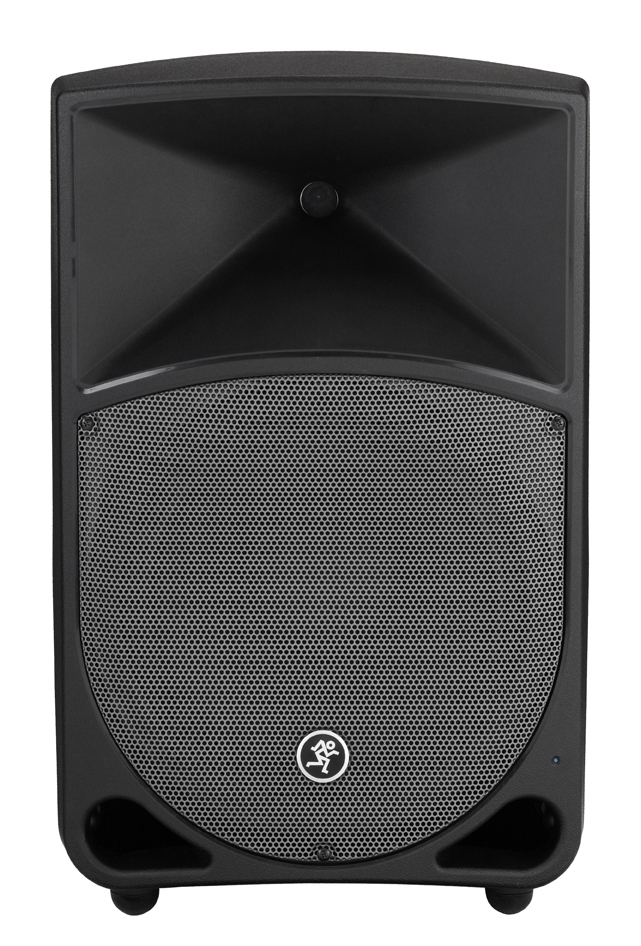
Mackie TH-12A ~$299 - On my initial audition plugging the HD500’s right XLR out directly into the TH-12A’s input I felt the 400 watt spec of the unit was a bit overstated. It seemed closer in volume to the 180 watt K1800FX. Referencing the spec sheet, the 400 watts is a peak figure and the unit is perhaps more accurately described as 150 watts to the woofer (class D power amp, 300 watts peak) and 50 watts to the tweeter (class Ab power amp, 100 watts peak). Still, things seemed like they should have been louder. So I tried hooking up a a cable with a ¼” jack on one end and XLR on the other to the HD500 and TH-12A respectively and...whoa momma! When fed a healthy line level signal (the POD HD500’s XLR’s signal strength is closer to mic level than line level) and cranking up the TH-12A has a punchy low end, rich mid range, and articulate yet smooth highs. Though carrying the “Thump” name, the Mackie TH-12A was by far the flattest sounding of the group despite the spec sheet showing a response tilted towards the low mids with a rather drastic fall off around 100hz. Goosing the low end at high volumes results in a very slight rattle however the three band EQ (bypassable with sweepable mids) is very effective at tightening up the low end. I’ve used it in a number of rehearsals and a couple gigs thus far and its performed very admirably. But it ain’t all roses...as the unit is a high wattage affair it does exhibit some hiss. Now, hiss is acceptable to me to some degree in this scenario as when cranked up to performance levels its really unnoticeable. However, there is a built in noise gate which kicks in to squelch the hiss when there is no signal coming through the unit. As such under the microscope of low volume bedroom playing the hiss cutting in and out can quickly become bothersome and I much prefer using something designed for lower volume performance. Minor quibbles aside, the unit sounds darn nice at rehearsal/gigging volumes and to top it all off it only weighs 25 pounds!
In summary, I would likely choose the Behringer B212D for DJ work, electronic drums, and potentially even a compact FOH system given an external dedicated EQ. If I needed a full blown budget PA, the feature-to-volume ratio of the K1800FX is tough to beat. But the TH-12A just sounded the best for my specific rig. Its got more than enough volume for my current needs and if I needed wider disbursement in short order, I could have one fairly easily due to local availability. So for this round, the Mackie TH-12A gets the gig.
566 views